Involve · Youth-led funding
Youth-Led Funding Toolkit for Local Areas
Money for young people, decided with young people. A practical guide for councils, charities and local partners who set up or run funding for young people, and for the young people who help decide where it goes. It moves you from asking young people what they think to deciding with them, at any size of pot, from a £300 trip to a multi-year programme.
- Section
- Youth-led funding
- Format
- Access
- Open access
At a glance
- 12young people aged 14 to 18 designed it
- 3online design workshops, September and October 2026
- 8stages in the funding journey
- 16tools and templates to use straight away
- 12local case studies, from Frome to North Ayrshire
- 60+published sources read for the evidence review
What's inside
Section by section
Each block is one part, sized by its number of pages. Choose a part to open the PDF at that page.
- Start hereTwo doors in, one for adults and one for young people, the applicant's journey, the journey map and two one-page summaries.pp. 4–11
- 1. Why this existsThe young people's headlines, a note from DCMS, and the six themes from what young people said.pp. 12–14
- 2. Five things adults forgetThe communication commitment; coaches, not bosses; time and pay; know why and be known; skilled facilitation.pp. 15–20
- 3. Five principles, written as testsEach principle as a test you can fail, with a real pass and a real fail.pp. 21–23
- 4. Four example ways of doing itGrant panels, the vote, delegated budgets and youth-informed commissioning, plus models that fit none of them and a decision helper.pp. 24–35
- 5. The funding journey: eight stagesFor every stage: what goes wrong, what good looks like, a checklist for adults and what young people can ask for.pp. 36–48
- 6. Tools and templatesSixteen tools, from an example application to jargon bingo.pp. 49–58
- 7. When it goes wrongWhat to do when a round stalls, is overturned, runs out of money or loses its young people.pp. 59–60
- 8. Keeping it goingBuilding a fund that survives a restructure, and refreshing the room each year.pp. 61–62
- 9. Jargon jar41 funding words in plain English, defined by the young people.pp. 63–65
- 10. StoriesYoung people's own stories, stage by stage, and twelve local case studies.pp. 66–69
- 11. The registerWhat young people asked for, what happened to it, and why.pp. 70–71
- 12. Who made thisHow it was built, so you can trust it, and how to do the same thing locally.pp. 72–73
- AppendixWhere the examples come from: 40 sources.pp. 74–75
Print and share
The one-page summaries
Each one works on its own: print it for a panel, a team meeting or a youth group.
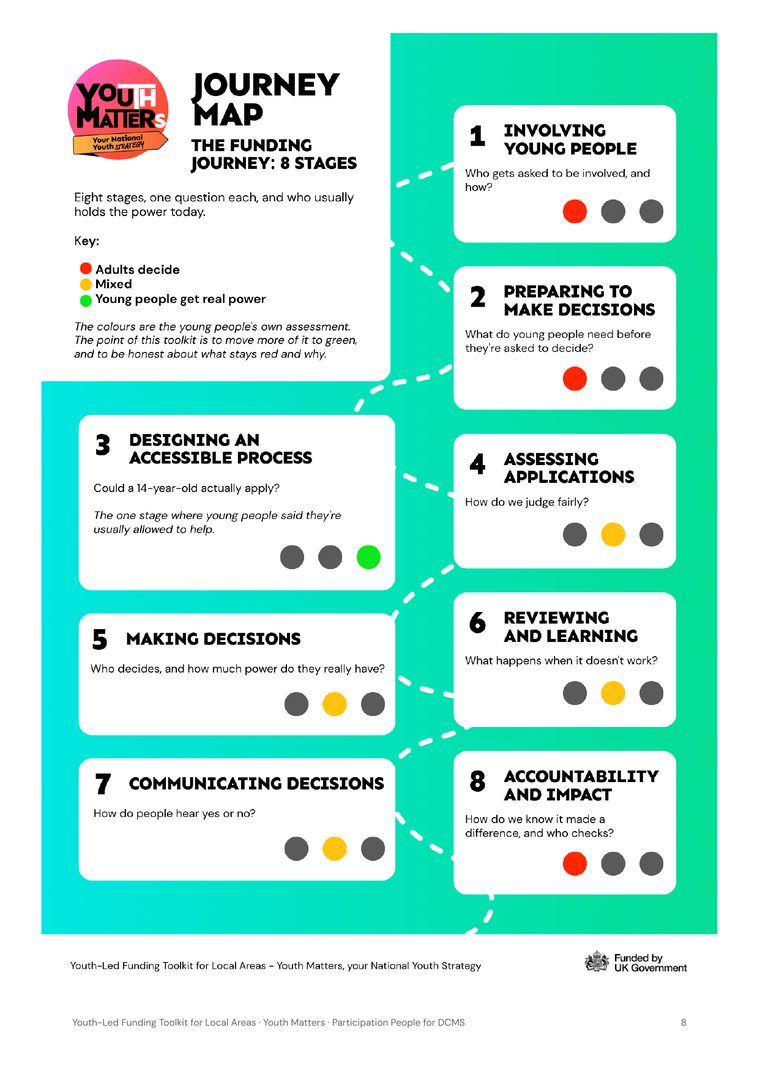 The journey mapEight stages, one question each, and who usually holds the power today.Page 8 of the PDF
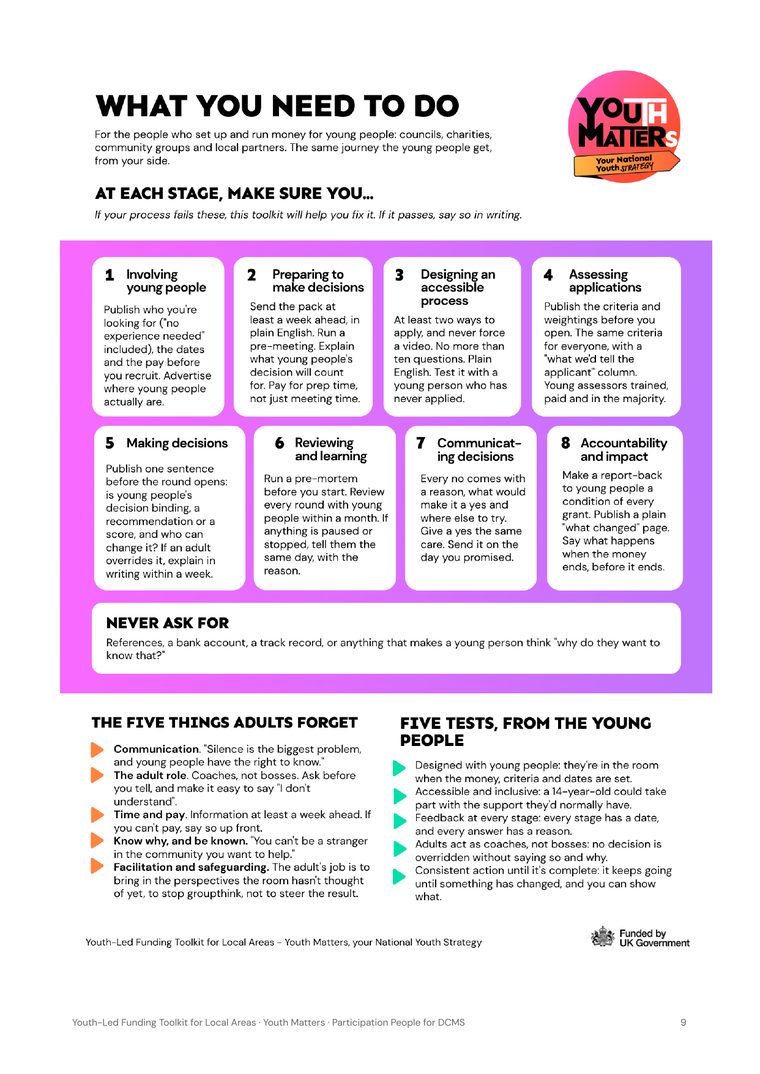 What you need to doThe one-page summary for the adults who set up and run the fund.Page 9 of the PDF
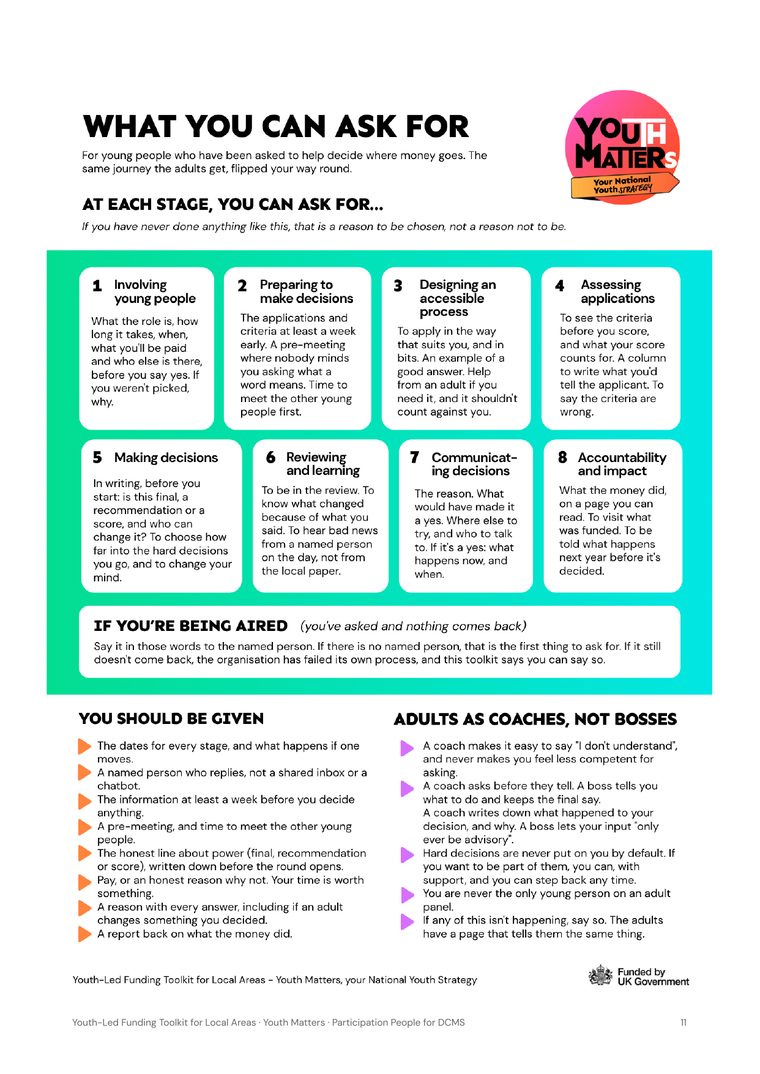 What you can ask forThe same journey, flipped round for young people on a panel.Page 11 of the PDF
The journey
The funding journey: eight stages
Each stage asks one question. The young people who designed the toolkit marked who usually holds the power at each stage today. The point is to move more of it to young people, and to be honest about what stays with adults and why.
Stage 1: Involving young people
Who gets asked to be involved, and how?
Who usually decides today: Adults decide
Stage 2: Preparing to make decisions
What do young people need before they are asked to decide?
Who usually decides today: Adults decide
Stage 3: Designing an accessible process
Could a 14-year-old actually apply?
Who usually decides today: Young people get real power
Stage 4: Assessing applications
How do we judge fairly?
Who usually decides today: Mixed
Stage 5: Making decisions
Who decides, and how much power do they really have?
Who usually decides today: Adults decide
Stage 6: Reviewing and learning
What happens when it doesn't work?
Who usually decides today: Mixed
Stage 7: Communicating decisions
How do people hear yes or no?
Who usually decides today: Adults decide
Stage 8: Accountability and impact
How do we know it made a difference, and who checks?
Who usually decides today: Adults decide
How you know it is youth-led
Five principles, written as tests
The toolkit doesn't ask what your model is called. It asks whether it passes five tests, agreed by the young people, each one a test a local area can fail.
- Test 1
Designed with young people
Fails if: Young people are brought in after the pot, the criteria or the timetable have been fixed.
- Test 2
Accessible and inclusive
Fails if: There is only one way to apply or take part, or a 14-year-old couldn't do it with the support they would normally have.
- Test 3
Feedback at every stage
Fails if: Anyone hears no (or yes) without a reason, or a stage passes with no update.
- Test 4
Adults act as coaches, not bosses
Fails if: An adult overrides a young person's decision without saying so and why, or leads the conversation when they were asked to support it.
- Test 5
Consistent action until it's complete
Fails if: The process stalls, the money is spent and nobody can point to what changed, or a decision isn't written down.
Ways of doing it
Four example ways of doing it
Examples, not a menu: most local areas blend two or build their own. Each comes with a real place that has done it.
Youth grant panel
Young people assess applications and recommend or decide which groups get grants.
Done in practiceGannochy Trust, Perth and Kinross: twelve young people aged 14 to 25 hold written authority to approve up to £100,000 a year.
Participatory budgeting
A wide group of young people propose ideas and vote on how a pot is spent.
Done in practiceNorth Ayrshire: 4,131 young people cast 12,393 votes on almost 100 projects sharing £56,000 in 2022.
Delegated budget
A youth group, youth council or youth bank holds a budget of its own and decides how to spend it.
Done in practiceSouthwark: a cabinet decision put 10% of a £1.15 million youth fund directly in young people's hands.
Youth-informed commissioning
Young people help write what a service should do and help choose who provides it.
Done in practiceGloucestershire: young people's scores, weighted at 15%, funded three projects the adult panel had rejected.
How much power each one really gives young people, from page 24
Ready to use
Sixteen tools to use on Monday morning
Each tool answers something young people said. Adapt them; don't make them longer.
- The example application
- Assessment criteria and scoring sheet
- The "no, but" message
- The yes message
- The communication commitment
- The adult briefing
- The impact review clause
- The pay and time guide
- The model decision helper
- The review-and-learn checklist
- The pre-mortem
- The one sentence about power
- The who-took-part check
- Panel terms of reference
- The power barometer
- Jargon bingo
In young people's words
“You don't improve from being aired.”
Kaiden. Being aired is when you say something and get no response.
“It's more about being collaborative rather than young people being less.”
Isla, on adults as coaches, not bosses
“Silence is the biggest problem, and young people have the right to know.”
The young people's verdict on how funds communicate
Behind it
How it was made
DCMS worked with Participation People and twelve young people to produce the toolkit. The young people, aged 14 to 18 and from across the UK, three of them new to funding on purpose, designed it. An adult design group from DCMS, Young Manchester, Libraries Rising, HUDL Youth Development Agency and The Blagrave Trust tested every draft against what happens inside councils, funders and youth organisations.
Protected by the young people
Three parts they said must survive stakeholder testing untouched:
- Adults as coaches, not bosses
- The feedback loop, and keeping the promise of it
- The communication commitment
- Workshop 1
Mapped the eight-stage journey from their own experience, agreed five principles and named what the toolkit must make impossible.
- Workshop 2
Gave every section a keep, change or cut verdict, then built the example application and the pre-mortem.
- Workshop 3
Tested the whole draft in role, as a council officer, a small charity, a first-time applicant and a panel member, and wrote the jargon jar.
- The evidence
A review of more than 60 published sources, interviews, and real working documents from councils and funders sent in by more than 40 people and organisations.
- The receipt
After every session the young people got a decision receipt: what you said, what we did, what's still open. The register in section 11 publishes the count.
Who it's for
- Council officers
- Charities and community groups
- Funders and grant-makers
- Commissioners
- Young Futures Hubs
- Young people on panels
“The voices you hear make the changes you see.”Yash, 18, one of the young people who designed the toolkit
Related resources
Whole library → 
Learning & case studies
Child and Youth Participation in Philanthropy: Stories of Transformation
Learning & case studies
Listening Fund Young Advisors' Learning Journey
Learning & case studies